Jagannath Rath Yatra 2026: Full Story of the Chariot Festival and Interesting Facts
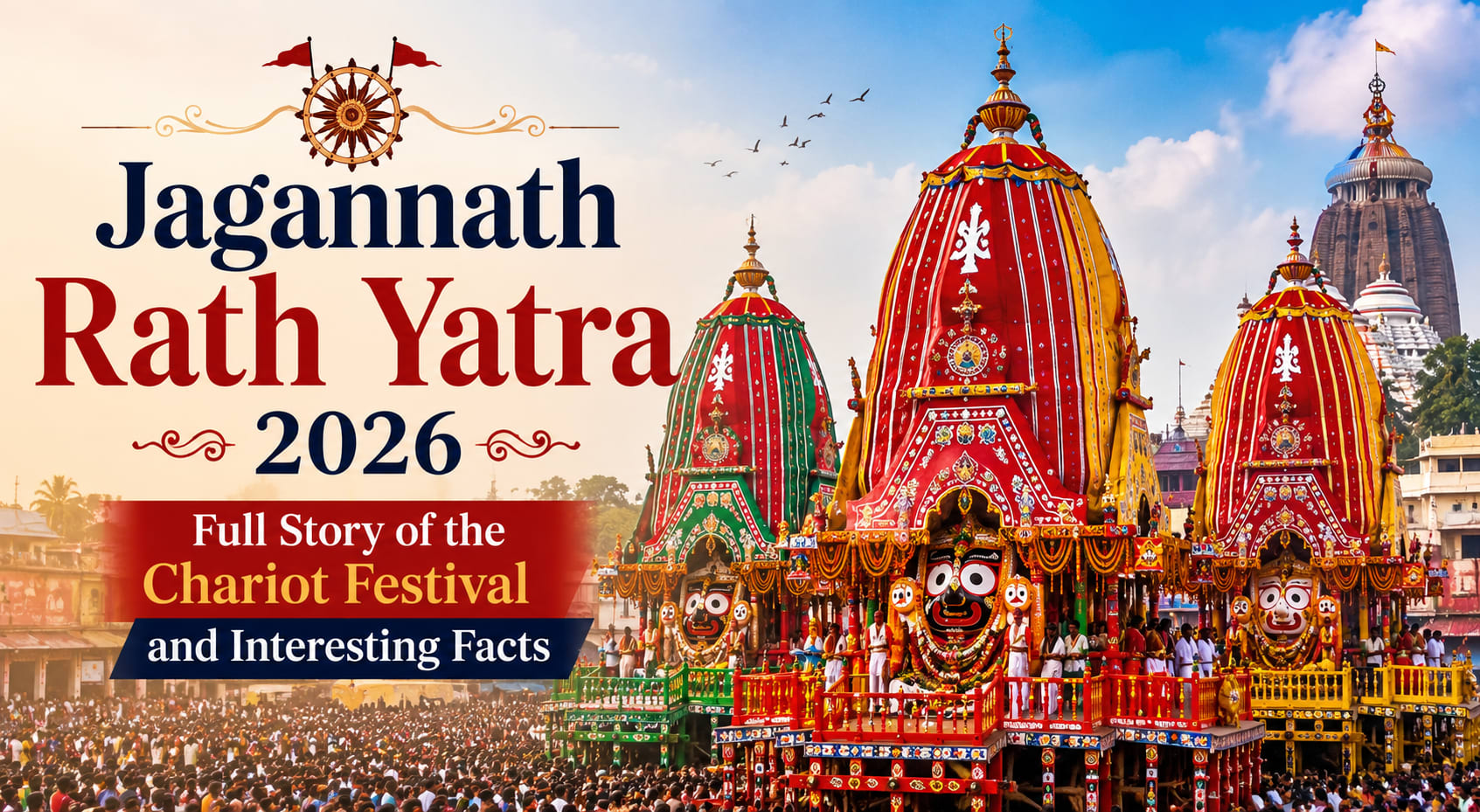
Jagannath Rath Yatra 2026 falls on Thursday, 16 July, when Lord Jagannath, Lord Balabhadra and Devi Subhadra leave the sanctum of the Jagannath Temple in Puri and travel to the Gundicha Temple on three massive wooden chariots. This guide walks you through the complete story behind the festival, its ritual calendar, and some genuinely interesting facts about India's oldest chariot festival. You can explore festival dates, temple profiles and panchang details on DevMarg, India's trusted spiritual companion.
Key highlights
- Jagannath Rath Yatra 2026 falls on Thursday, 16 July (Ashadha Shukla Dwitiya).
- The deities travel roughly 3 km from the Jagannath Temple to the Gundicha Temple along Puri's Bada Danda, the Grand Road.
- Three brand-new wooden chariots are built every year — Nandighosha, Taladhwaja and Darpadalana.
- The return journey, Bahuda Yatra, is on 24 July 2026, and the festival closes with Niladri Bije around 27 July.
Jagannath Rath Yatra 2026: Key Dates at a Glance
| Event | Details |
|---|---|
| Main Rath Yatra | Thursday, 16 July 2026 (Ashadha Shukla Dwitiya) |
| Snana Purnima (ceremonial bath) | 29 June 2026 |
| Bahuda Yatra (return journey) | Friday, 24 July 2026 |
| Niladri Bije (deities re-enter temple) | Around 27 July 2026, confirm nearer the date |
| Location | Jagannath Temple to Gundicha Temple, Bada Danda, Puri, Odisha |
| Three chariots | Nandighosha (Jagannath), Taladhwaja (Balabhadra), Darpadalana (Subhadra) |
What Is Jagannath Rath Yatra?
Jagannath Rath Yatra, also called the Festival of Chariots, is an annual Hindu festival held in Puri, Odisha. Lord Jagannath, a form of Lord Vishnu, along with his elder brother Lord Balabhadra and younger sister Devi Subhadra, comes out of the Jagannath Temple and travels roughly three kilometres along the Bada Danda, the Grand Road of Puri, to the Gundicha Temple.
Most Hindu festivals bring devotees to the deity. Rath Yatra reverses this. The deity comes out to meet the devotees, and anyone, regardless of caste, religion or background, can stand on the Bada Danda and have darshan, or even hold the ropes and help pull the chariots. This openness is one of the reasons Rath Yatra is considered such a unique festival in Sanatan Dharma.
The Full Story Behind Jagannath Rath Yatra
Rath Yatra began, according to tradition, because Devi Subhadra wished to see the world outside the temple and visit her aunt at the Gundicha Temple, and her brothers Jagannath and Balabhadra took her there by chariot. This one journey, repeated every year since, grew into the festival known today. The fuller story behind it involves a lost idol, an unfinished carving and a temple built centuries later.
The Legend of King Indradyumna and Neela Madhava
According to the Skanda Purana and local Odia tradition, King Indradyumna of Malwa once dreamed of Lord Vishnu in the form of Neela Madhava, an idol worshipped secretly by a tribal chief named Vishwavasu deep in a forest. The king sent his priest Vidyapati to find this idol, but by the time royal messengers reached the spot, the idol had vanished into the sand, leaving only a piece of sacred wood, or daru, floating in the sea near Puri.
Vishwakarma and the Unfinished Idols
The king was told in a dream to have new images carved from this wood. The celestial architect Vishwakarma agreed to carve the idols, but on one condition — that no one disturb him while he worked behind closed doors. After many days of silence, the queen grew anxious and opened the door too soon. Vishwakarma left the carving incomplete, without properly formed hands and feet. This is why the idols of Jagannath, Balabhadra and Subhadra look distinct from most Hindu deity images. Devotees see this as a reminder that the divine can never be fully captured in any single form.
Why the Journey to Gundicha Temple?
Regional tradition holds that the annual journey fulfils a wish of Devi Subhadra, who wanted to see the world outside the temple walls and visit her aunt at the Gundicha Temple. Another layer of meaning comes from the Katha Upanishad, which compares the human body to a chariot, the intellect to its driver, and the soul's journey through life to the movement of the ratha itself. Seen this way, Rath Yatra is not only a historical procession but a living symbol of the soul's journey toward the divine.
A Second Reading: Krishna's Longing for Mathura
A related tradition, more common among Vaishnav communities outside Odisha, reads the same journey differently. Jagannath is identified with Krishna, and the yearly trip is seen as Krishna's symbolic wish to revisit Mathura, the place of his birth, along with Balarama and Subhadra. Both readings — the Subhadra version rooted in Odisha and the Mathura version popular in Bengal and among ISKCON communities — are told side by side today, and DevMarg presents both respectfully rather than favouring one over the other.
A Tradition Older Than the Temple Itself
The present Jagannath Temple in Puri was built in the 12th century CE by King Anantavarman Chodaganga Deva of the Eastern Ganga dynasty. However, references to chariot processions of deities appear in earlier Puranic literature, suggesting the underlying tradition is considerably older than the temple structure that stands in Puri today.
The Three Sacred Chariots
Every year, three brand-new chariots are built from scratch for the festival. None of them survive to the next year. More than a thousand carpenters, painters and tailors work for weeks to construct them using centuries-old techniques, without a single iron nail. Only wooden pegs and joints hold the structure together.
| Chariot | Deity | Approx. Height | Wheels | Canopy Colour |
|---|---|---|---|---|
| Nandighosha | Lord Jagannath | 45 feet | 16 | Red and yellow |
| Taladhwaja | Lord Balabhadra | 44 feet | 14 | Red and green |
| Darpadalana | Devi Subhadra | 43 feet | 12 | Red and black |
The wood comes from specific trees, mainly Phassi, Dhausa and Asana, sourced from the Dasapalla and Ranpur forests of Odisha. For every tree felled to build a chariot, new saplings are planted — an old, informal practice of ecological renewal built into the ritual.
Jagannath Rath Yatra 2026: Full Ritual Calendar
The main procession is only one part of a festival that unfolds over several weeks. Here is how the sequence is expected to look in 2026, based on the Hindu Panchang and reports from the Shree Jagannath Temple Administration.
| Ritual | 2026 Date | What Happens |
|---|---|---|
| Snana Purnima | 29 June | Deities are bathed with 108 pots of sacred water |
| Anasara (seclusion) | 30 June to 13 July | Deities stay out of public view, believed to be unwell after the bath |
| Nabajaubana Darshan | 14 July | First public appearance after seclusion, with freshly painted eyes |
| Rath Yatra | 16 July | Main chariot procession from Jagannath Temple to Gundicha Temple |
| Hera Panchami | 20 July | Goddess Lakshmi visits the Gundicha Temple, a ritual tied to a local legend |
| Bahuda Yatra | 24 July | Return journey of the chariots toward the main temple |
| Suna Besha | 25 July | Deities are adorned in gold ornaments on the chariots |
| Niladri Bije | Around 27 July | Deities re-enter the sanctum, marking the end of the festival |
Key Rituals Explained
- Pahandi Bije: Priests carry the deities from the sanctum to the chariots in a rhythmic, swaying movement called Pahandi Bije, accompanied by chanting and music.
- Chhera Pahara: Before the chariots move, the Gajapati King of Puri, the traditional royal head of the temple, sweeps the chariot platforms with a golden broom and sprinkles sandal water. Even the king performs this act of humility, showing that everyone stands equal before Lord Jagannath.
- Chariot Pulling: Thousands of devotees pull the massive chariots along Bada Danda using thick ropes. Touching or pulling the rope is considered a rare form of seva open to anyone present, without restriction.
- The Dahuka: The charioteer of each ratha, known as Dahuka, is traditionally believed to encourage the chariot to move through rhythmic calls, a custom rooted in old agrarian folk traditions of Odisha.
- Stay at Gundicha Temple: The deities stay at the Gundicha Temple for about a week before their return journey, the Bahuda Yatra, back to the main temple.
15 Interesting Facts About Jagannath Rath Yatra
- Older than it looks: The present Jagannath Temple dates to the 12th century, but references to chariot processions of deities appear in earlier Puranic texts, meaning the underlying tradition predates the temple building itself.
- The word juggernaut: The English word juggernaut, meaning an unstoppable force, comes directly from Jagannath. It entered English through the 14th-century Franciscan friar Odoric of Pordenone, who described the massive chariots after visiting Puri.
- Wooden, not stone: Unlike most Hindu deities carved in stone or cast in metal, the murtis of Jagannath, Balabhadra and Subhadra are made of wood and are ceremonially replaced in a rare ritual called Nabakalebara, held only in specific years decided by the lunar calendar.
- Rebuilt every single year: None of the three chariots is reused. All of them are dismantled after the festival, and completely new ones are built from scratch the following year, right down to the wheels and canopy.
- Not one metal nail: The chariots are assembled entirely using wooden pegs and joints, a carpentry technique passed down for generations within specific hereditary families of craftsmen.
- A small forest, replanted: The specific trees used for the chariots, mainly Phassi, Dhausa and Asana, are sourced from Odisha's Dasapalla and Ranpur forests, and new saplings are traditionally planted to replace every tree that is felled.
- The king sweeps the floor: In the Chhera Pahara ritual, the Gajapati King of Puri personally sweeps the chariot platforms with a golden broom before the procession starts, a public act of humility that has continued for centuries.
- Family order in the procession: Balabhadra's chariot leads the procession, followed by Subhadra, and then Jagannath, reflecting their order as siblings.
- Unfinished by design: Local legend explains that the idols look unfinished, without fully carved hands and feet, because the divine sculptor Vishwakarma was interrupted before completing his work — a detail devotees see as symbolic rather than accidental.
- One of the world's largest kitchens: The temple kitchen, known as Rosaghara, is widely described as one of the largest community kitchens in the world, capable of preparing Mahaprasad, cooked in earthen pots, for tens of thousands of people at a time.
- A global festival: Rath Yatra processions are now organised in more than a hundred countries, largely through ISKCON temples, in cities such as London, New York, Toronto and Singapore.
- Open to everyone: Rath Yatra is one of the few Hindu rituals where people of any background can take part directly by helping pull the chariot ropes on the open street, without needing to enter the temple itself.
- Nothing goes to waste: After the festival, wood from the dismantled chariots is often reused as fuel in the temple kitchen or distributed to devotees as sacred keepsakes.
- The birthplace of rasagola, by legend: According to popular belief in Odisha, Niladri Bije is linked to the origin of rasagola. Lord Jagannath is said to offer the sweet to Goddess Lakshmi to calm her after his return, and many locals mark this day as the sweet's symbolic birthday.
- A weather folklore: Many devotees and residents of Puri believe that rain has accompanied the festival in most years, a piece of local folklore passed down alongside the ritual itself rather than a verified meteorological record.
Frequently Asked Questions
Q. When is Jagannath Rath Yatra in 2026?
The main Rath Yatra procession falls on Thursday, 16 July 2026, corresponding to Ashadha Shukla Dwitiya in the Hindu Panchang.
Q. Can non-Hindus watch or take part in Rath Yatra?
Yes. Anyone can watch the procession and even help pull the chariot ropes along Bada Danda. However, entry inside the Jagannath Temple's sanctum remains restricted to Hindus, following long-standing temple tradition.
Q. Why are the chariots destroyed and rebuilt every year?
Building fresh chariots each year reflects the Hindu idea of impermanence and renewal. It also keeps alive a specialised carpentry tradition that has been passed down through hereditary craftsman families for generations.
Q. What is the significance of Bahuda Yatra?
Bahuda Yatra is the return journey of the three deities from the Gundicha Temple back to the main Jagannath Temple, expected on 24 July 2026. It marks the final stretch of the festival before Niladri Bije.
Q. Where does the word Juggernaut come from?
It comes from Jagannath. European travellers who witnessed the enormous chariots being pulled through Puri centuries ago used the term to describe an overwhelming, unstoppable force, and it eventually entered common English usage.