
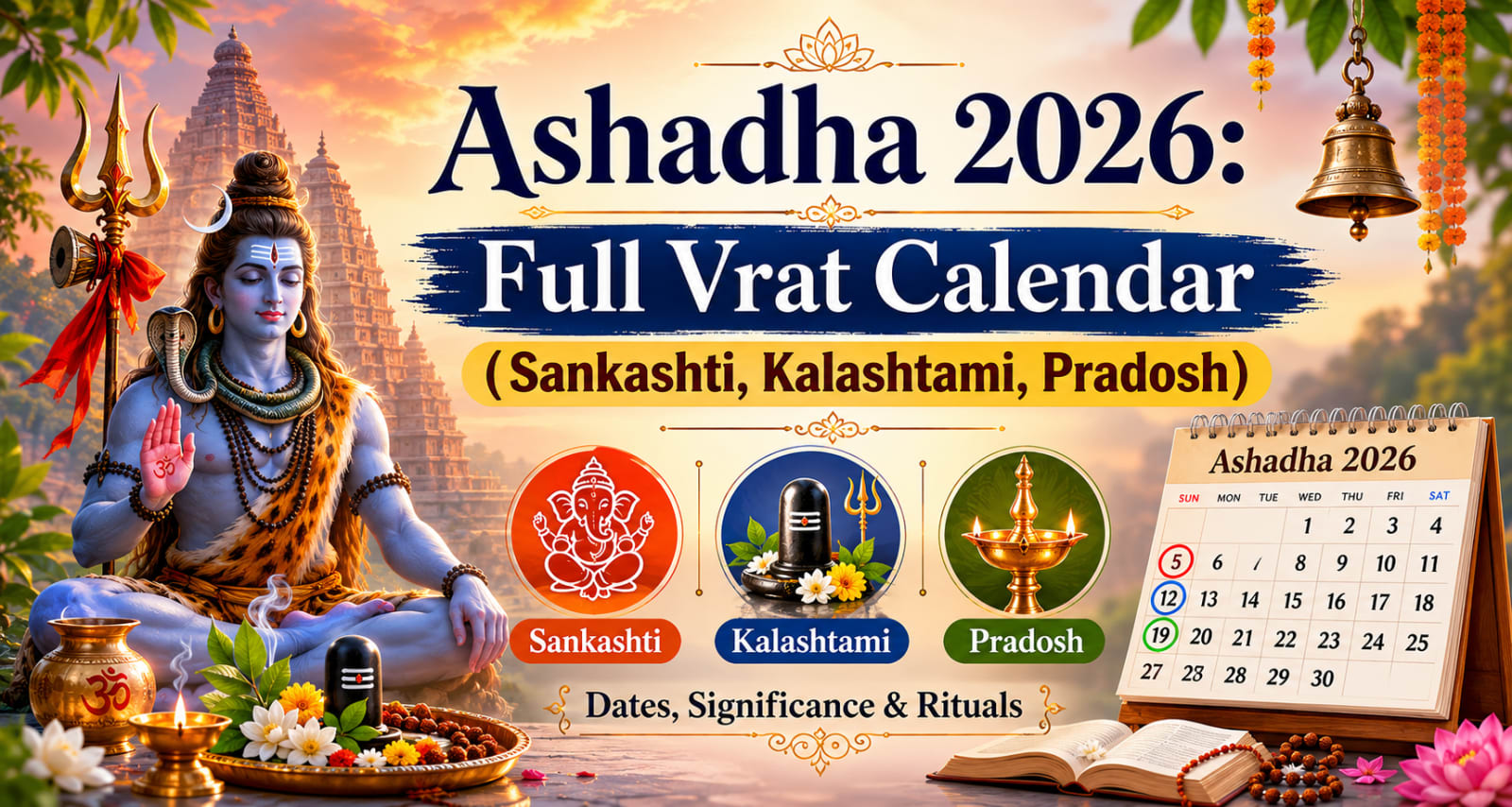
Ashadha 2026: Full Vrat Calendar (Sankashti, Kalashtami, Pradosh)
Ashadha is one of the most spiritually active months in the Hindu calendar. It marks the start of Chaturmas, the four-month holy period when devotees turn inward with fasting, prayer, and seva. In 2026, this month carries a long list of vrats — and because 2026 has an extra lunar month earlier in the year, all these dates fall later than they did in 2025.
This guide gives you the complete, verified Ashadha 2026 vrat calendar, with the date and tithi for every important fast — Sankashti Chaturthi, Kalashtami, both Pradosh Vrats, the Ekadashis, Amavasya, and Guru Purnima. For each one, you'll also find why it matters, how it is observed, and the best time to do the puja.
When is Ashadha in 2026? (Direct Answer)
The Ashadha month in 2026 runs from 30 June to 29 July 2026. The month begins the day after Jyeshtha Purnima and ends on Ashadha Purnima (Guru Purnima). All vrat dates below are calculated for India.
Here is the full list of Ashadha 2026 vrats and festivals at a glance:
| Vrat / Festival | Day & Date (2026) | Tithi |
|---|---|---|
| Krishnapingala Sankashti Chaturthi | Friday, 3 July | Krishna Chaturthi |
| Kalashtami | Tuesday, 7 July | Krishna Ashtami |
| Yogini Ekadashi | Friday, 10 July | Krishna Ekadashi |
| Pradosh Vrat (Ravi Pradosh) | Sunday, 12 July | Krishna Trayodashi |
| Masik Shivaratri | Monday, 13 July | Krishna Chaturdashi |
| Ashadha Amavasya | Tuesday, 14 July | Amavasya |
| Devshayani (Ashadhi) Ekadashi | Saturday, 25 July | Shukla Ekadashi |
| Pradosh Vrat (Ravi Pradosh) | Sunday, 26 July | Shukla Trayodashi |
| Guru Purnima (Ashadha Purnima) | Wednesday, 29 July | Purnima |
A quick note for readers outside India: vrats like Sankashti and Pradosh depend on moonrise and sunset, which change from city to city. In a few places the fast may fall a day earlier or later. Always confirm the exact timing on your local panchang for the day.
What is Ashadha?
Ashadha is the fourth month of the Hindu lunar calendar. It comes after Chaitra, Vaishakha, and Jyeshtha, and falls around June and July in the English calendar.
The month gets its name from the Purva Ashadha and Uttara Ashadha nakshatras (star groups). The full moon of this month usually sits near one of these stars, and that is how the month is named.
Ashadha is closely tied to the arrival of the monsoon in India. As the first rains fall and the earth turns green, the mood of the month becomes calm and reflective. It is seen as a good time to slow down, pray, and look inward.
The month is also spiritually important for one big reason: it begins Chaturmas. On Devshayani Ekadashi, which falls in Ashadha, Lord Vishnu is believed to enter a long rest, and the four holy months of fasting and devotion begin. This is why Ashadha is filled with so many vrats, and why families pause weddings and other large events until Chaturmas ends.
Why Ashadha 2026 Falls Later Than Usual
If you noticed that this year's dates feel "late," you are right. The reason is Adhik Maas, also called the leap month.
The Hindu calendar follows the moon, while our daily life follows the sun. To keep the two in step, an extra lunar month is added roughly every three years. In 2026, this Adhik Maas fell between 17 May and 15 June. That extra month pushed every festival after it about three weeks later than in 2025.
So when you compare 2026 dates with last year's, do not assume they simply repeat. This is exactly why checking a current-year panchang matters, and why we verified each date below against live tithi timings.
Sankashti Chaturthi — Friday, 3 July 2026
Krishnapingala Sankashti Chaturthi falls on Friday, 3 July 2026. It is the fourth day (Chaturthi) of the dark fortnight, dedicated to Lord Ganesha.
Sankashti means "deliverance during difficult times." Devotees believe that fasting on this day and praying to Lord Ganesha helps remove obstacles and brings peace and success. The fast is kept from sunrise and broken at night, only after seeing the moon and offering arghya (water).
How it is observed:
- Wake early, bathe, and take a sankalp (vow) to keep the fast.
- Offer durva grass, modak, sesame (til), and jaggery to Lord Ganesha.
- Chant the Vakratunda Mahakaya mantra or recite Ganesha Chalisa.
- Break the fast after moonrise with a simple sattvic meal.
Best time: The main puja is done in the evening, and the fast ends after moonrise. Moonrise time changes by city, so check your local panchang for the exact minute.
Kalashtami — Tuesday, 7 July 2026
Kalashtami in Ashadha falls on Tuesday, 7 July 2026. Observed on the eighth day (Ashtami) of the dark fortnight, this day is dedicated to Kaal Bhairav, a fierce form of Lord Shiva.
Devotees worship Kaal Bhairav to remove fear, negativity, and hidden troubles, and to seek protection for the family. Many visit Bhairav temples on this day or light a lamp in the evening at home.
How it is observed:
- Worship Lord Bhairav with a diya, black sesame, and mustard oil.
- Recite the Bhairav Chalisa or Bhairav Ashtakam.
- Some devotees feed dogs, which are linked to Lord Bhairav, as an act of seva.
Best time: Puja is usually done at night, since Kaal Bhairav is associated with the night hours.
Yogini Ekadashi — Friday, 10 July 2026
Yogini Ekadashi falls on Friday, 10 July 2026. This Ekadashi comes in the dark fortnight of Ashadha and is dedicated to Lord Vishnu.
It is believed to wash away faults and bring health and inner peace. Devotees keep a fast, avoid grains, and spend the day in prayer and the reading of Vishnu's name. The fast is broken the next morning (Parana) within the correct time window.
The Two Pradosh Vrats in Ashadha 2026
Ashadha 2026 has two Pradosh Vrats — one in each fortnight. Pradosh Vrat is observed on Trayodashi (the thirteenth tithi) and is dedicated to Lord Shiva and Goddess Parvati.
- First Pradosh: Sunday, 12 July 2026 (Krishna Paksha). Because it falls on a Sunday, it is called Ravi Pradosh.
- Second Pradosh: Sunday, 26 July 2026 (Shukla Paksha). This one is also a Sunday, so it is again Ravi Pradosh.
Ravi Pradosh (Sunday) is believed to bring good health and long life. The name of each Pradosh changes with the weekday — Soma Pradosh on Monday, Bhauma on Tuesday, Shani on Saturday, and so on — and each carries its own blessing.
| First Pradosh | Second Pradosh | |
|---|---|---|
| Date | Sunday, 12 July 2026 | Sunday, 26 July 2026 |
| Paksha | Krishna Paksha | Shukla Paksha |
| Tithi | Krishna Trayodashi | Shukla Trayodashi |
| Type (by weekday) | Ravi Pradosh | Ravi Pradosh |
| Puja window | Pradosh Kaal (after sunset) | Pradosh Kaal (after sunset) |
How Pradosh Vrat is observed:
- Keep a day-long fast, taken lightly with fruit and water by many.
- The main worship is done in the evening, in the Pradosh Kaal — the roughly two-hour window just after sunset.
- Offer water, bilva (bel) leaves, and a lamp to a Shivling, and chant "Om Namah Shivaya."
Best time: Pradosh Kaal begins at sunset and lasts about two hours. In most of India this is roughly between 7:00 PM and 9:00 PM, but it shifts with your local sunset, so confirm on the panchang for that day.
If keeping a full Shiv puja at home feels difficult on a working Sunday, many families arrange a guided Pradosh or Rudrabhishek puja with a verified pandit so the rituals are done correctly and on time.
Devshayani Ekadashi — Saturday, 25 July 2026
Devshayani Ekadashi falls on Saturday, 25 July 2026. This is the most important Ekadashi of the month and marks the start of Chaturmas.
It is believed that Lord Vishnu enters yoga nidra (cosmic sleep) on this day and wakes four months later on Prabodhini Ekadashi. During Chaturmas, many families pause weddings and other big celebrations and focus instead on fasting, charity, and devotion.
Ashadha Amavasya — Tuesday, 14 July 2026
Ashadha Amavasya falls on Tuesday, 14 July 2026. Since it falls on a Tuesday, it is also known as Bhaumvati Amavasya.
The new-moon day is considered ideal for remembering ancestors through tarpan and for charity. Many devotees take a holy dip in a river, light a lamp, and offer food to the needy.
Guru Purnima (Ashadha Purnima) — Wednesday, 29 July 2026
Guru Purnima falls on Wednesday, 29 July 2026, the full-moon day that closes the month of Ashadha.
This is the day to honour our gurus — our teachers, our parents, and the guides who lead us from confusion to clarity. It is also called Vyasa Purnima, marking the birth of Sage Veda Vyasa, who is honoured as the Adi Guru, the teacher of teachers. The same full moon is sacred to Buddhists, who remember the Buddha's first sermon at Sarnath.
How it is observed:
- Seek the blessings of your guru and your elders by touching their feet.
- Perform Guru puja, recite the "Guru Brahma, Guru Vishnu" shloka, and many also keep a Satyanarayan Vrat.
- Offer charity such as food, yellow cloth, or books to students and those in need.
Which Deity Does Each Vrat Honour?
Each vrat in Ashadha is linked to a particular deity and a particular blessing. This quick table makes it easy to see at a glance.
| Vrat | Deity | Sought Blessing |
|---|---|---|
| Sankashti Chaturthi | Lord Ganesha | Removal of obstacles |
| Kalashtami | Lord Kaal Bhairav | Protection, freedom from fear |
| Yogini Ekadashi | Lord Vishnu | Health, purity, and peace |
| Pradosh Vrat | Lord Shiva & Parvati | Health, well-being, harmony |
| Devshayani Ekadashi | Lord Vishnu | Begins Chaturmas devotion |
| Guru Purnima | Guru / Veda Vyasa | Wisdom, gratitude, learning |
Frequently Asked Questions
What is the Ashadha month? Ashadha is the fourth month of the Hindu lunar calendar, falling around June–July. It marks the start of the monsoon and the beginning of Chaturmas, the four-month holy period of fasting and devotion.
What are the most important vrats in Ashadha 2026? The most observed vrats are Sankashti Chaturthi (3 July), Kalashtami (7 July), Yogini Ekadashi (10 July), the two Pradosh Vrats (12 and 26 July), Devshayani Ekadashi (25 July), and Guru Purnima (29 July).
When are the Pradosh Vrats in Ashadha 2026? There are two Pradosh Vrats — Sunday, 12 July 2026 and Sunday, 26 July 2026. Both fall on a Sunday, so both are Ravi Pradosh.
On which date is Sankashti Chaturthi in July 2026? Sankashti Chaturthi (Krishnapingala Sankashti) is on Friday, 3 July 2026. The fast is broken after moonrise.
What date is Guru Purnima in 2026? Guru Purnima is on Wednesday, 29 July 2026. It is also known as Ashadha Purnima and Vyasa Purnima.
Why are the 2026 vrat dates later than in 2025? 2026 had an extra lunar month, Adhik Maas, from 17 May to 15 June. This pushed the festivals that follow it about three weeks later than the previous year.
Can the vrat dates change for my city? Yes. Fasts like Sankashti and Pradosh depend on moonrise and sunset, which differ by location. In some cities the date may shift by a day, so always check your local panchang for the exact timing.
Conclusion
Ashadha is a month that gently turns our attention from the outside world to our inner life. From the obstacle-clearing fast of Sankashti, to the calm evening worship of Pradosh, to the gratitude of Guru Purnima, each vrat is a small chance to pause and reconnect.
Keep this calendar handy, mark the dates that matter to your family, and confirm the exact muhurat on your local panchang as each day arrives. Whether you observe these vrats quietly at home or wish to have the rituals performed by a verified pandit, what matters most is the shraddha — the faith — you bring to them.