
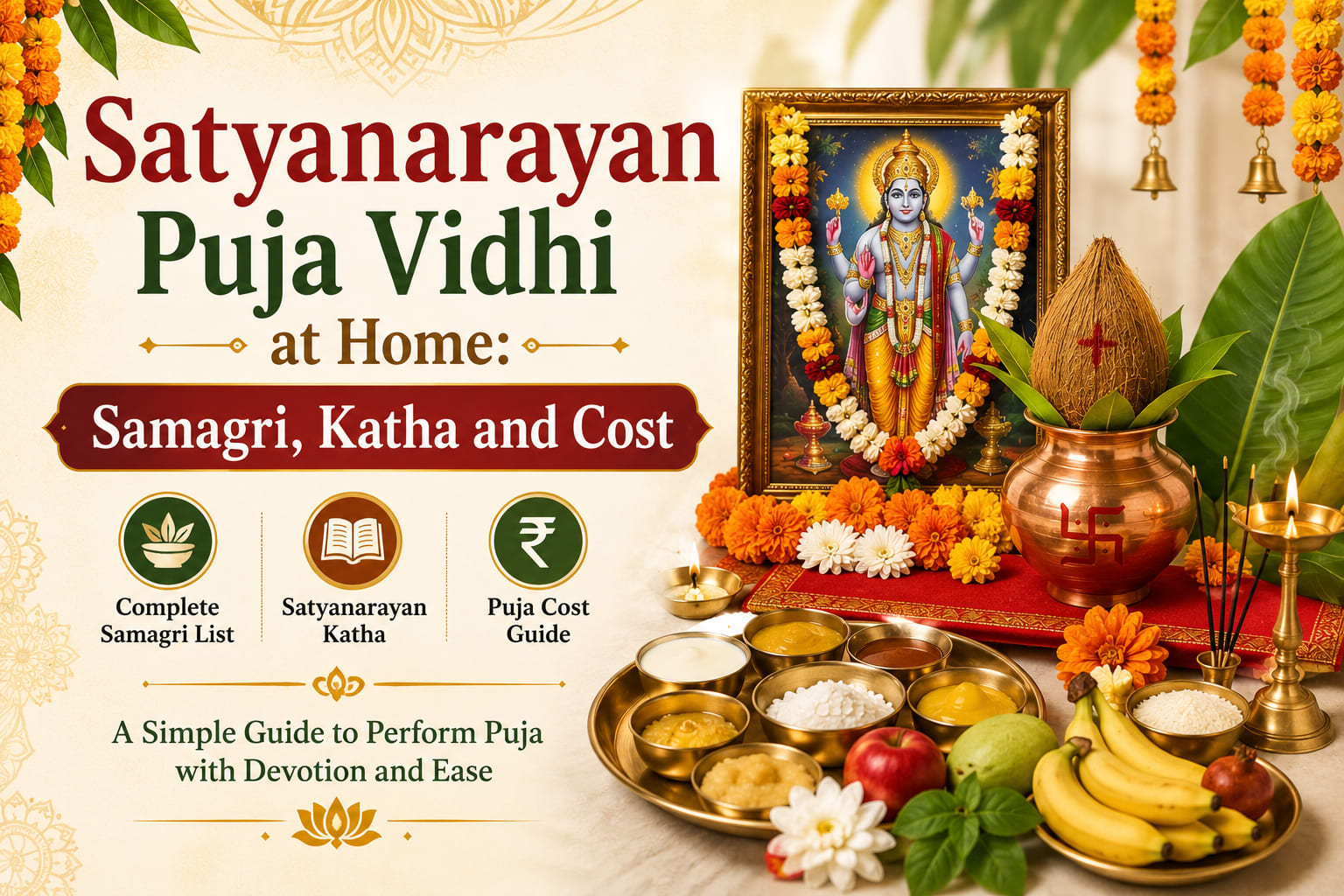
Satyanarayan Puja Vidhi at Home: Samagri, Katha and Cost
Satyanarayan Puja is one of the simplest and most loved Vishnu pujas done in Indian homes. Families perform it on a new beginning, on a fulfilled wish, or simply to invite peace into the house. You do not need a temple or a grand setup. A clean spot, a few items, and a sincere heart are enough.
This guide explains everything in one place. You will learn what the puja means, the full samagri list, the step-by-step vidhi, the meaning of the Katha, the best dates in 2026, and a clear idea of the cost. The aim is to help you do it correctly and with full devotion.
What Is Satyanarayan Puja?
Satyanarayan Puja is a worship of Lord Vishnu in his form as Satyanarayan, the Lord of Truth. The word Satya means truth, and Narayan is a name of Vishnu. The puja is performed to seek his blessings for prosperity, harmony, and the removal of obstacles in family life.
The ritual is described in the Reva Khanda of the Skanda Purana. In the story, Sage Narada asks Lord Vishnu for an easy way to relieve human suffering. The Lord replies that the Satyanarayan Vrat is a simple and powerful remedy that anyone can follow. Because of this, the puja can be done by any person on most days, without complex rules.
The heart of the puja is the Satyanarayan Katha, a set of five short stories read aloud during the ritual. Listening to the Katha with faith is considered as important as the worship itself.
Why Families Perform Satyanarayan Puja
Most families perform this puja to express gratitude and to ask for the well-being of everyone at home. It is a moment when relatives sit together, listen to the Katha, and share prasad. That togetherness is part of its value.
People commonly perform Satyanarayan Puja on these occasions:
- After moving into a new home, along with or soon after Griha Pravesh
- After a wedding, an engagement, or a child's naming ceremony
- On a birthday or a wedding anniversary in the family
- After a wish is fulfilled, as a thank you to the Lord
- At the start of a new business or a new job
- Every Purnima, as a regular monthly vrat taken by some families
The puja is believed to bring calm, clear thinking, and a positive feeling to the home. It is not tied to any single goal. Families adapt it to their own occasion and intention.
When to Do Satyanarayan Puja: Best Time and 2026 Dates
Satyanarayan Puja can be done on almost any day. The most auspicious choice is Purnima, the full moon day. Many families also choose Ekadashi, Sankranti, or a Thursday, since Thursday is linked to Lord Vishnu. The evening, during the Pradosh period after sunset, is considered the ideal time of day.
If you are marking a specific event like a housewarming, you can do the puja on the day of that event itself, after checking a good muhurat.
Here are the most auspicious Purnima dates for Satyanarayan Puja in 2026 for India. Every Purnima in the year is suitable, so this list covers the major ones across the months.
| Purnima | Date in 2026 (India) | Day |
|---|---|---|
| Magha Purnima | 1 February | Sunday |
| Vaishakh (Buddha) Purnima | 1 May | Friday |
| Guru Purnima (Ashadha) | 29 July | Wednesday |
| Shravan Purnima (Raksha Bandhan) | 28 August | Friday |
| Sharad Purnima (Ashwin) | 26 October | Monday |
| Kartik Purnima | 24 November | Tuesday |
Dates are cross-referenced with Drik Panchang for India. Tithi timings shift by city, so the puja day can fall one day earlier or later in some regions. Please confirm the local panchang for your city on the chosen date, especially if you are abroad.
Kartik Purnima and Vaishakh Purnima are seen as especially holy for Vishnu worship. If you want a single date with strong significance, either of these is a fine choice.
Satyanarayan Puja Samagri List
Keeping all items ready a day before makes the puja smooth and unhurried. The list below covers a standard home puja. Quantities depend on your family size.
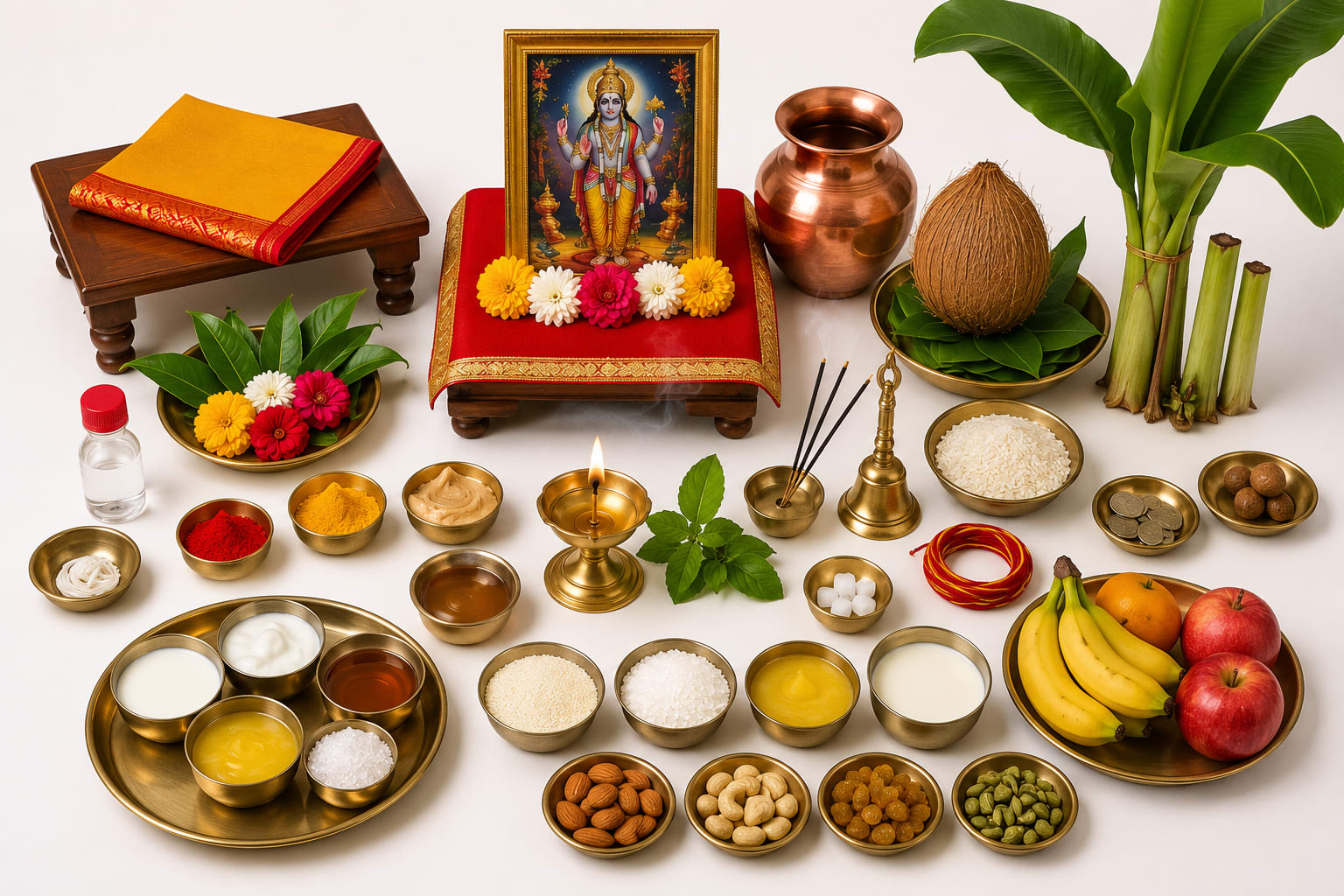
For the setup and the deity
- A photo or small idol (murti) of Lord Satyanarayan or Lord Vishnu
- A wooden chowki (low table)
- A clean yellow or red cloth to cover the chowki
- Banana stems or a small banana plant to make a mandap, if available
- Mango leaves and fresh flowers for decoration
For the Kalash
- A copper or brass kalash (pot)
- A whole coconut
- Betel leaves (paan) and betel nuts (supari)
- Raw rice (akshat) and a few coins
- A sacred thread (mauli or kalava)
For worship (puja items)
- Roli, kumkum, haldi (turmeric), and sandalwood paste (chandan)
- Incense sticks (agarbatti), dhoop, camphor (kapoor), and cotton wicks
- A diya with ghee or oil
- Gangajal in a small container
- Tulsi leaves, which are essential for Vishnu puja
- A small bell (ghanti)
For the offering (naivedya and prasad)
- Panchamrit, made of milk, curd, ghee, honey, and sugar
- Fresh fruits, especially bananas
- Items to make the prasad: semolina (sooji or rava), sugar, ghee, milk, and ripe bananas
- A few dry fruits and a little cardamom for the prasad
If any small item is missing, do not worry. Devotion and cleanliness matter more than a perfect list. Many families also keep a printed copy of the Katha so everyone can follow along.
How to Make Satyanarayan Prasad (Sheera)
The classic prasad is a soft semolina halwa called sheera or panjiri. Many families add banana to it, which gives the prasad its familiar taste.
A simple method:
- Heat ghee in a pan and roast the semolina on low flame until it turns light golden and smells fragrant.
- In a separate pan, warm milk with sugar until the sugar dissolves.
- Slowly add the warm milk to the roasted semolina while stirring, so no lumps form.
- Mix in mashed banana, a little cardamom, and some chopped dry fruits.
- Cook for a few minutes until it thickens, then offer it to the Lord as bhog before sharing.
Some regional traditions follow their own recipe or avoid certain ingredients. Follow the custom your family has kept.
Satyanarayan Puja Vidhi: Step by Step at Home
You can perform this puja yourself or with a pandit. The steps below follow the common North Indian order. The full ritual usually takes about ninety minutes to two hours.
- Clean and prepare the space. Bathe and wear fresh clothes. Clean the puja area and place the chowki in the north-east corner if possible. Spread the cloth and set the idol or photo on it.
- Make the mandap and kalash. Decorate with mango leaves and flowers. Fill the kalash with water, place betel leaves around the rim, and set the coconut on top. This kalash represents the divine presence.
- Light the diya and take a sankalp. Light the lamp and incense. Then take the Sankalp, a short vow where you state your name, your gotra, the date, and the reason for the puja. This sets your intention for the worship.
- Worship Lord Ganesha first. As in every Hindu ritual, invoke Lord Ganesha at the start so that obstacles are removed and the puja goes smoothly.
- Worship the Kalash and Navagraha. Offer worship to the kalash and to the nine planets (Navagraha) to bring balance and positive energy.
- Worship Lord Satyanarayan. Offer flowers, tulsi leaves, chandan, kumkum, incense, and the panchamrit to the Lord. Place the fruits and the prepared prasad before him as naivedya.
- Read the Satyanarayan Katha. This is the most important part. Read all five chapters of the Katha aloud while the family listens with folded hands. Many keep some raw rice in their palm and release it after each chapter. A family member can also blow the conch (shankh) once each chapter ends.
- Perform the Aarti. After the Katha, perform the Satyanarayan Aarti with the lit camphor or diya. Ring the bell and sing the aarti together.
- Distribute the prasad. Share the prasad and panchamrit with everyone present. Offering prasad to family, neighbours, and guests is part of completing the vrat.
Satyanarayan Katha: The Five Chapters
The Katha is a collection of five short stories. Each one carries a simple lesson about faith, truth, and keeping one's promises. Reading or hearing the full Katha is considered essential to the puja.
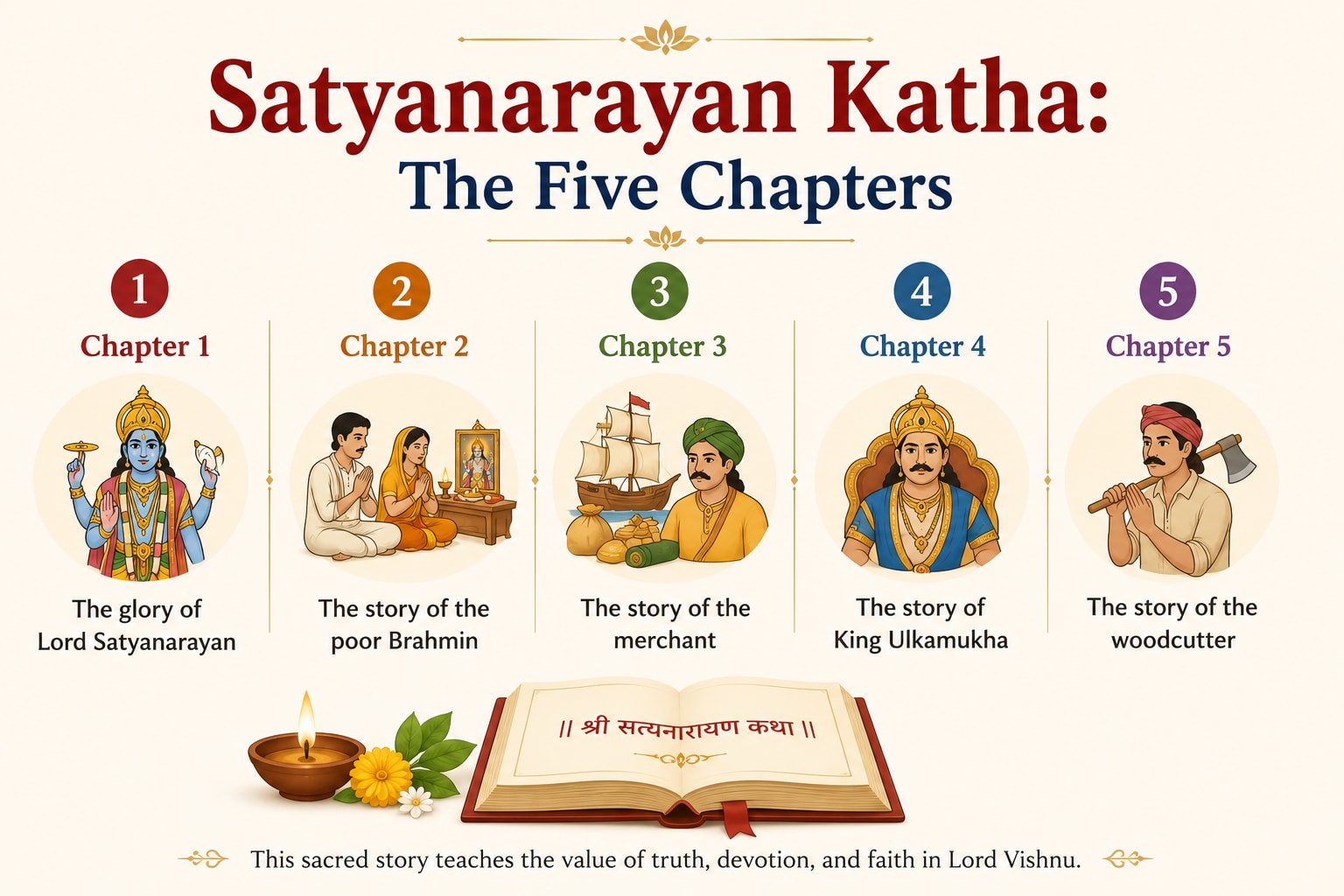
Here is a summary of the five chapters:
- The origin of the Vrat. Sage Narada sees the suffering of people on Earth and asks Lord Vishnu for help. The Lord describes the Satyanarayan Vrat as an easy path to peace and prosperity.
- The poor Brahmin. A poor Brahmin performs the vrat with faith and finds relief from his hardship. A woodcutter who learns about it from him also performs it and prospers.
- The merchant's delay. A wealthy merchant promises to perform the puja but keeps delaying it. His neglect brings him trouble until he keeps his word.
- The lesson of Kalavati. The story of Kalavati shows what happens when the prasad is treated carelessly and how respect for the puja restores good fortune.
- King Tungadhwaj's pride. A king ignores the puja out of arrogance and faces loss. He understands his mistake, takes part with humility, and his troubles end.
The common thread is clear. Keep your word, stay humble, and treat the puja and its prasad with respect.
As a small custom, a family member can blow the conch (shankh) after each chapter of the Katha ends. The sound is considered auspicious and marks the close of one adhyay before the next begins.
Satyanarayan Puja Cost in 2026
The cost of a Satyanarayan Puja depends on your city, whether you book a pandit, and whether the samagri is included. You can do it on a small budget at home, or choose a full-service package where everything is arranged for you.
Here is a realistic guide based on common rates in India in 2026:
| Option | Typical Cost (India, 2026) | What It Covers |
|---|---|---|
| Samagri only, no pandit | ₹500 to ₹1,500 | You buy the items and perform the puja yourself |
| Pandit Dakshina only | ₹1,100 to ₹3,100 | Pandit conducts the puja, and you arrange the samagri |
| Standard package | ₹2,100 to ₹6,500 | Pandit plus complete samagri arranged for you |
| Elaborate package | ₹6,000 to ₹15,000 and above | Pandit, samagri, havan, decoration, longer recitation |
A few points worth knowing:
- Metro cities such as Mumbai, Bangalore, Delhi, Hyderabad, and Pune often cost around ₹1,000 more than smaller towns.
- Festival days and popular Purnima dates can be a little higher because pandits are in demand. Booking early helps.
- A puja combined with Griha Pravesh or a havan will cost more, since it takes longer and uses more samagri.
- Ask for a clear, itemised quote before you confirm, so there are no surprises.
Prefer to have a verified pandit and all the samagri arranged for you, at home or online? Book a Pandit with DevMarg →
Common Mistakes to Avoid
- Do not skip or shorten the Katha. Reading all five chapters is the core of the vrat.
- Do not forget tulsi leaves. They are important in any Vishnu worship.
- Keep the prasad respectfully and share it with everyone. The Kalavati story is a reminder of this.
- Try to keep a sattvic, vegetarian diet on the day of the puja.
- If you take a Sankalp to do the puja yearly, make an effort to keep that promise.
Frequently Asked Questions
Can I do Satyanarayan Puja without a pandit? Yes. The puja is simple enough to do at home with a printed vidhi and Katha. A pandit helps with correct chanting and is often preferred for big occasions like Griha Pravesh, but it is not compulsory.
Is fasting necessary for Satyanarayan Puja? Fasting is not compulsory. Many people keep a light fast or eat only sattvic food until the puja is complete. The fast is broken with prasad after the aarti.
On which day should I do the puja? Purnima is the most auspicious day. Ekadashi, Sankranti, and Thursdays are also good. For an event like a housewarming, you can do it on that day after checking the muhurat.
How long does the puja take? A standard home puja takes about ninety minutes to two hours, including the Ganesh puja, kalash worship, the five-chapter Katha, the aarti, and prasad distribution.
What is the main prasad for this puja? The main prasad is sheera, a sweet semolina halwa usually made with sooji, ghee, sugar, milk, and banana. Panchamrit is also offered and shared.
Can the puja be done for the whole family from abroad? Yes. Many families living outside India arrange an online Satyanarayan Puja where a pandit performs it on their behalf, and they join over a video call. The prasad and recording can be shared with them afterwards.
What is the best time of day to perform Satyanarayan Puja? The evening, during the Pradosh period just after sunset, is considered the best time for Satyanarayan Puja. Morning is also fine if evening is not possible. Choose a time when the whole family can sit together for the Katha.
Can Satyanarayan Puja be done alone, or do you need many people? You can perform it alone with full devotion. There is no minimum number of people required. Families usually do it together because sitting for the Katha and sharing prasad as a group is part of the tradition.
Can women perform Satyanarayan Puja? Yes. Any person can perform Satyanarayan Puja, including women. In many homes, women lead the worship and the Sankalp. The puja has no restrictions based on gender.
What should be offered as bhog to Lord Satyanarayan? The main bhog is sheera, a sweet semolina halwa made with sooji, ghee, sugar, milk, and banana. Panchamrit and fresh fruits, especially bananas, are also offered. Tulsi leaves are placed on the bhog before offering.
What is the difference between Satyanarayan Puja and Satyanarayan Katha? Satyanarayan Puja is the full ritual, including the Sankalp, kalash worship, offerings, and aarti. The Satyanarayan Katha is the reading of the five stories, which is an important part of that puja. The Katha is always read as part of the complete puja.
Which colour clothes should be worn for the puja? Yellow is the preferred colour, since it is linked to Lord Vishnu. White or other light, clean colours are also suitable. The main point is to wear fresh, clean clothes after a bath.
How often should a family perform Satyanarayan Puja? There is no fixed rule. Some families do it once for a special occasion, some every Purnima, and many perform it once a year as a gesture of gratitude. It depends on the Sankalp or vow you take.
Can Satyanarayan Puja be performed for Griha Pravesh? Yes. It is one of the most recommended pujas for a housewarming. It is believed to purify the new home, settle Vastu concerns, and invite peace and prosperity. It is usually done on the Griha Pravesh day after a suitable muhurat.
Why is the banana important in Satyanarayan Puja? Banana is offered to Lord Satyanarayan as a favourite fruit and is also mixed into the prasad. Banana leaves and stems are often used to decorate the mandap. It is treated as a pure and auspicious offering in this puja.
Can anyone perform Satyanarayan Puja regardless of caste? Yes. The scriptures describe this vrat as open to everyone, without any restriction of caste, status, or background. This simplicity is one reason the puja is so widely performed across India.
Conclusion
Satyanarayan Puja is a gentle and meaningful way to invite peace and gratitude into your home. It asks for little, yet it brings the family together around a shared moment of faith. With a clean space, the right samagri, and the Katha read with devotion, you can perform it beautifully at home.
If you would like a verified pandit to conduct the puja or to arrange everything for you, DevMarg is here to guide you. May Lord Satyanarayan bless your home with truth, harmony, and prosperity.