
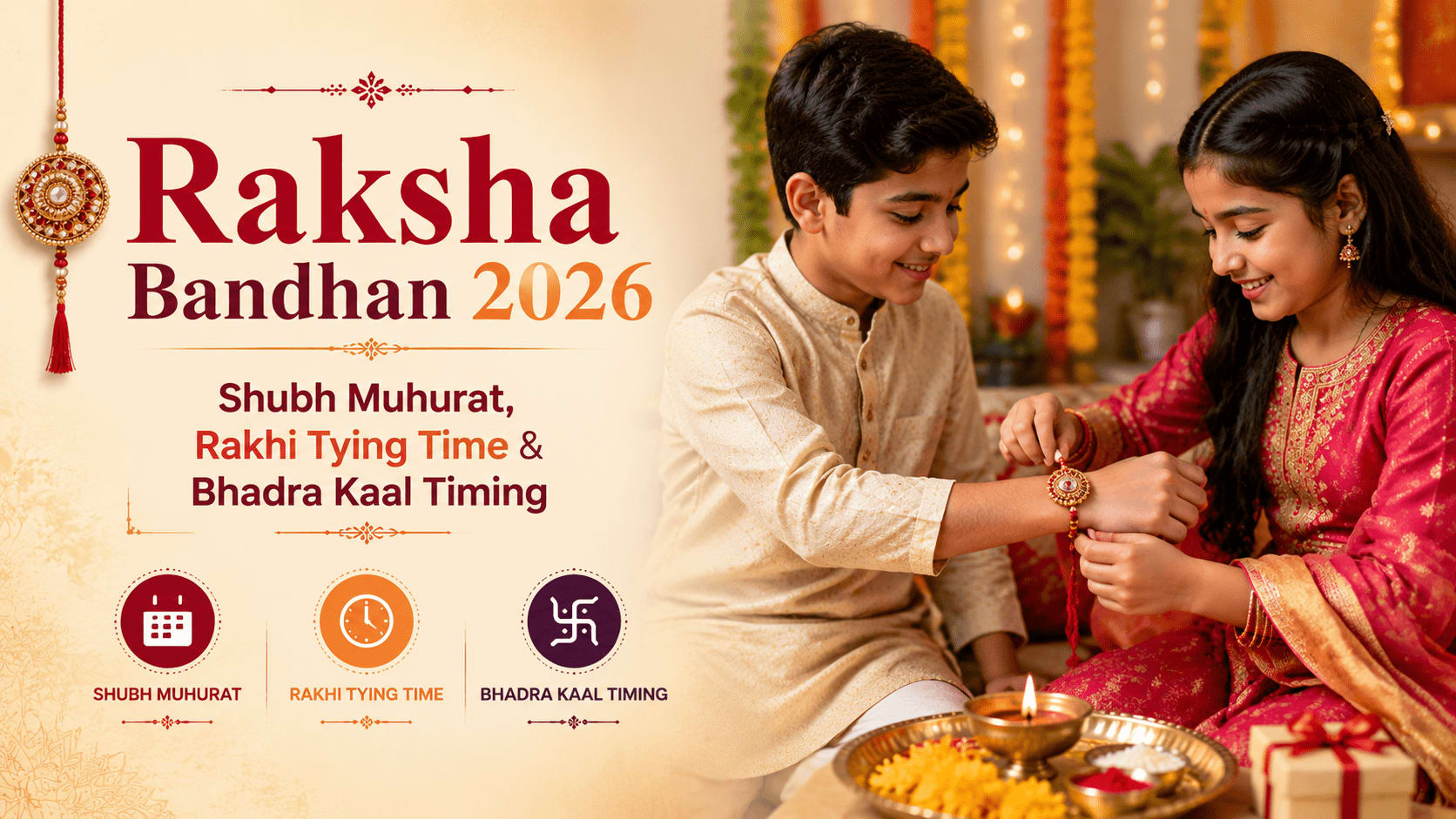
Raksha Bandhan 2026: Shubh Muhurat, Rakhi Tying Time & Bhadra Kaal Timing
Raksha Bandhan 2026 will be celebrated on Friday, 28 August. This is the day sisters across India tie the sacred rakhi thread on their brothers' wrists, praying for their long life and well-being, while brothers promise to protect and support their sisters in return.
The shubh muhurat to tie rakhi in 2026 falls between 5:57 AM and 9:48 AM IST, according to the New Delhi panchang. This year brings good news for most families: Bhadra Kaal ends well before sunrise on 28 August, so the entire morning window is free from the traditional restriction, and you can perform the ceremony at any comfortable time within it.
| Key Timing | Detail |
|---|---|
| Festival date | Friday, 28 August 2026 |
| Purnima Tithi ends | 9:48 AM, 28 August |
| Shubh muhurat | 5:57 AM – 9:48 AM (3h 51m) |
| Bhadra Kaal | Ends before sunrise — no clash |
Why Raksha Bandhan Matters
Raksha Bandhan, which literally means "the bond of protection," is one of the most heartfelt festivals in the Hindu calendar. It is observed every year on Shravana Purnima, the full moon day of the month of Shravana, and it celebrates the unique relationship between brothers and sisters.
The tradition carries deep cultural roots. Several stories are associated with it, including the account of Draupadi tying a strip of cloth on Lord Krishna's wrist and his promise to protect her in return, as well as the tale of Indrani tying a protective thread on Indra before a great battle. You can read more about these traditions and regional variations in our Raksha Bandhan festival guide, which covers the festival's mythology and how it is observed across different parts of India.
While the core ritual remains the same everywhere, the way families celebrate can vary between regions and communities. In some households, it is a simple, quiet ceremony; in others it becomes a full day of family gatherings, festive food, and gift exchanges. What stays constant is the sentiment: a promise of care and protection shared between siblings.
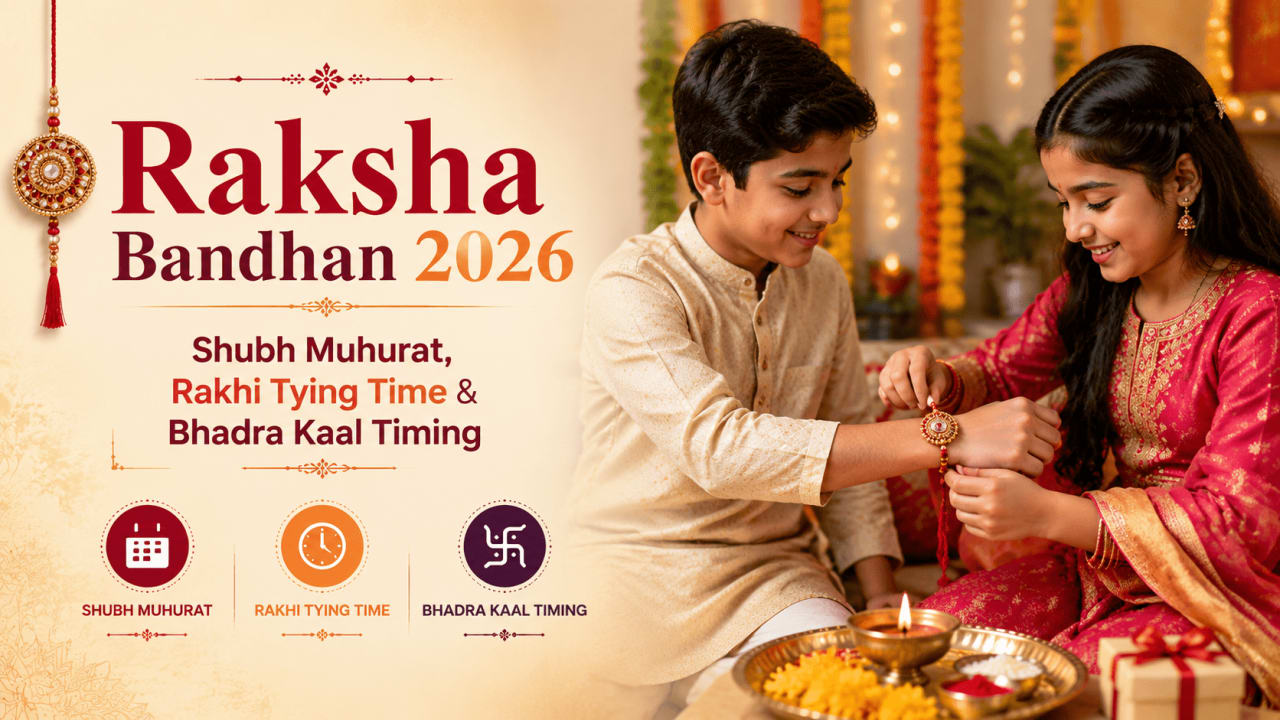
Rakhi Tying Vidhi: Step-by-Step Guide
Once the muhurat window arrives, the ceremony itself is simple and can be completed in a few minutes. Here is the traditional sequence most families follow:
- Prepare the thali with a rakhi, roli (vermilion), rice grains, a small diya, and sweets.
- Both brother and sister should bathe and wear clean or festive clothes before the ceremony begins.
- Seat the brother facing east or north, which is considered the most auspicious direction for the ritual.
- The sister applies a tilak of roli and rice on the brother's forehead.
- She performs a short aarti with the diya, moving it gently in front of him.
- The rakhi is then tied around the brother's right wrist.
- The brother offers sweets to his sister, and in many families, a gift follows as a token of his promise to protect and support her.
This sequence can be adapted slightly depending on family and regional custom. For a fuller explanation of each step, along with regional variations across North, West, South, and East India, see our complete Raksha Bandhan guide. The tilak applied during the ceremony carries its own meaning, explained in this guide to the spiritual meaning of tilak and kumkum, and the short aarti that follows is covered in our piece on the significance of Aarti.
Shubh Muhurat and Bhadra Kaal Timing for 2026
Why the Purnima Tithi Shows Two Dates
The Purnima Tithi for Raksha Bandhan 2026 begins at 9:08 AM on 27 August and ends at 9:48 AM on 28 August. Because the tithi spans two calendar days, some calendars and apps may list 27 August as well. Hindu festivals are generally observed on the day when the tithi prevails at sunrise, which is why Raksha Bandhan 2026 is celebrated on 28 August across India.
Understanding Bhadra Kaal
Bhadra Kaal, also known as Vishti Karana, is a period in the panchang that is traditionally considered unfavourable for beginning auspicious activities, including tying the rakhi. In 2026, Bhadra falls on 27 August from 9:09 AM to 9:32 PM and clears well before sunrise on 28 August, so the traditional concern about avoiding Bhadra during the ceremony simply does not apply this year. If you want to understand how to read a panchang for yourself, including tithi, nakshatra, and karana, our guide to reading a panchang breaks it down in simple terms.
The Complete Muhurat Timeline
Here is how the day lines up, from the tail end of Bhadra to the periods worth avoiding in the evening:
| Period | Timing | Verdict |
|---|---|---|
| Bhadra Kaal | 27 Aug, 9:09 AM – 9:32 PM | Over before 28 Aug |
| Morning Muhurat | 28 Aug, 5:57 AM – 9:48 AM | ✔ Best time |
| Aparahna Kaal | 28 Aug, ~1:30 PM – 4:00 PM | Alternate, if morning missed |
| Pradosh Kaal | 28 Aug, ~6:30 PM – 8:00 PM | Traditionally avoided |
For New Delhi, the auspicious window to tie rakhi is from 5:57 AM to 9:48 AM on 28 August, a comfortable duration of about 3 hours and 51 minutes. The Purnima Tithi and Bhadra Kaal fall at the same clock moment nationwide; what shifts by city is the sunrise-linked muhurat window, which can vary by roughly 10 to 25 minutes. Always check today's muhurat for your own city before beginning the ceremony, especially if you plan to tie the rakhi close to either end of the window.
If your family follows the custom of tying rakhi in the afternoon, the Aparahna Kaal from roughly 1:30 PM to 4:00 PM on 28 August is the recommended alternate window. It is best to avoid the Pradosh Kaal, roughly 6:30 PM to 8:00 PM, which is traditionally considered unfavourable for the ceremony.
Muhurat for Gulf NRI Families
For families in the UAE, Saudi Arabia, Qatar, Kuwait, Bahrain, and Oman, here is the New Delhi muhurat converted to local Gulf time. As with the India timings, treat this as a guide and confirm with a local panchang where possible.
| Region | Time Zone | Local Muhurat, 28 August |
|---|---|---|
| UAE & Oman | GST / GMT+4 | 4:27 AM – 8:18 AM |
| Saudi Arabia, Qatar, Kuwait & Bahrain | AST / GMT+3 | 3:27 AM – 7:18 AM |
Conclusion
Raksha Bandhan 2026 falls on Friday, 28 August, with a generous morning muhurat from 5:57 AM to 9:48 AM and no Bhadra Kaal to work around. This makes it a comparatively easy year to plan the ceremony, whether you are gathering as a family at home or connecting with loved ones from afar. For families abroad staying connected to these traditions, our piece on Hinduism among the NRI diaspora looks at how these celebrations continue to evolve outside India.
Frequently Asked Questions
What is the exact date of Raksha Bandhan in 2026? Raksha Bandhan 2026 falls on Friday, 28 August, observed on Shravana Purnima.
Is Raksha Bandhan on 27 August or 28 August? It is on 28 August. The Purnima Tithi begins on 27 August but is not present at sunrise that day; it is present at sunrise on 28 August, which is why the festival is observed then.
What is the shubh muhurat to tie rakhi in 2026? For New Delhi, the auspicious window is 5:57 AM to 9:48 AM on 28 August, a duration of about 3 hours and 51 minutes.
Is there Bhadra Kaal to avoid on Raksha Bandhan 2026? No. Bhadra Kaal runs from 9:09 AM to 9:32 PM on 27 August and ends well before sunrise on 28 August, so the entire morning is free from the usual restriction this year.
Can rakhi be tied in the afternoon in 2026? Yes, if needed. The Aparahna Kaal, roughly 1:30 PM to 4:00 PM on 28 August, is the traditional alternate window. It is best to avoid the Pradosh Kaal from about 6:30 PM to 8:00 PM.
What if I miss the morning muhurat window? Use the Aparahna Kaal in the afternoon as the next best option, and try to complete the ceremony before the Pradosh Kaal begins in the evening.