
Ganesh Chaturthi Puja Vidhi at Home: Step-by-Step Sthapana Guide
Ganesh Chaturthi 2026 falls on Monday, September 14, and for most Indian households the day begins with one central ritual: the sthapana, or ceremonial installation, of Lord Ganesha's murti. The most auspicious window for this, the Madhyahna Muhurat, runs from approximately 11:02 AM to 1:31 PM in North India, with small variations by city. Contrary to a common assumption, this installation does not require a priest or an elaborate arrangement. A clean, dedicated space, a modest set of ritual items, and a family willing to observe the sequence with attention are sufficient to perform a Ganesh Chaturthi puja that stays faithful to the tradition observed across the country.
This guide sets out the complete home puja vidhi in five stages that build on one another: preparing the space, performing the sthapana with Prana Pratishtha, conducting the Shodashopachara or sixteen-step worship, sustaining the daily rhythm of aarti and offerings through the festival, and closing the celebration with visarjan. Each stage is explained with the reasoning behind it, not just the mechanics, so that a family observing the ritual for the first time understands both what to do and why it matters.
Key Highlights: Ganesh Chaturthi 2026
- Ganesh Chaturthi: Monday, September 14, 2026
- Chaturthi Tithi begins: 7:06 AM, September 14
- Chaturthi Tithi ends: 7:44 AM, September 15
- Madhyahna Sthapana Muhurat (New Delhi): 11:02 AM to 1:31 PM
- Festival month: Bhadrapada, Shukla Paksha
- Main visarjan (Anant Chaturdashi): Friday, September 25, 2026
Importance and Significance of the Home Puja
Ganesh Chaturthi commemorates the birth of Lord Ganesha, revered across Hindu tradition as the remover of obstacles and invoked at the start of any significant undertaking, whether a wedding, a housewarming, or the opening page of a new ledger. When a family brings the murti home for this festival, the idol is treated less as an object of worship and more as a guest of honour: woken with prayers each morning, offered fresh food through the day, and settled for the night with an evening aarti.
The scale of today's public celebrations owes much to Lokmanya Bal Gangadhar Tilak, who in the late nineteenth century turned Ganeshotsav into a community movement to bring people together under colonial rule. Yet home worship of Ganesha during this Chaturthi predates that public movement considerably, resting on the older belief that Ganesha's presence in the home clears the path for the festive season that follows, from Navratri through to Diwali. Our guide to Lord Ganesha, the remover of obstacles covers this devotion in more depth.
Stripped of its history, what the festival asks of a household is straightforward: a period of gratitude and discipline, observed through daily aarti, an offering of modak, and the unhurried routine of tending to Bappa's presence as a family, together, for as long as he stays.
Ganesh Chaturthi Puja Samagri List
A well-prepared samagri list is what separates a calm sthapana morning from a hurried one. It is worth assembling every item at least a day or two in advance, checked off category by category, so that nothing needs to be sourced at the last minute.
The Murti
- An eco-friendly Ganesh idol made of natural clay, paper mache, or shadu mati (avoid plaster-of-Paris idols, which are difficult to immerse safely at home)
For the Altar
- A wooden chowki or pedestal
- Red or yellow cloth to cover the chowki
- Rangoli colours
- Fresh flowers and a garland
- Mango leaves for a toran (door hanging)
- Betel leaves and areca nuts (paan-supari)
For Snana (Bathing) and Abhishek
- Panchamrit: milk, curd, ghee, honey, and sugar
- Clean water or Gangajal
- A small vessel (uddharini) and plate for the abhishek
For the Puja
- Akshata: raw rice mixed with a little turmeric
- Kumkum and haldi
- Chandan (sandalwood paste)
- Durva grass (21 blades, considered especially dear to Ganesha)
- Shami leaves, where available
- Incense sticks (agarbatti) and dhoop
- Camphor (kapoor) and a small plate to burn it on
- A diya, oil or ghee, and cotton wicks
- Matchbox
For Naivedya (Bhog)
- Modak: steamed or fried, Ganesha's favourite offering
- Banana and other seasonal fruits
- A whole coconut
- Jaggery or any home-made sweet
Tulsi leaves are traditionally not offered to Lord Ganesha, unlike most other deities; durva grass takes its place in this puja.
Step-by-Step Ganesh Chaturthi Puja Vidhi at Home
Step 1: Prepare the Home and the Puja Space
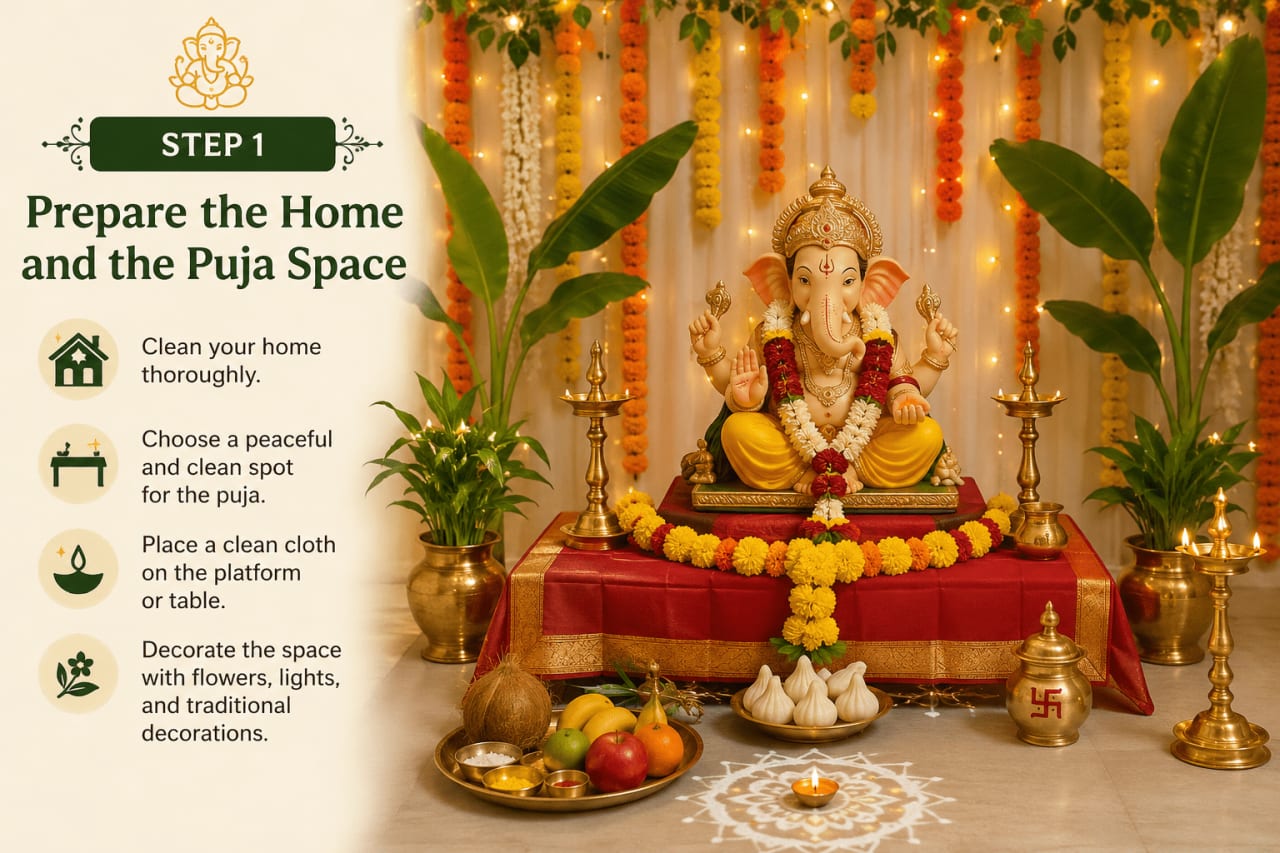
Tradition holds that Lord Ganesha should be welcomed into a home that is already clean and settled, so the preparation begins a day or two ahead, not on the morning itself. Set aside a quiet corner for the chowki, ideally one that faces east or northeast, and cover it with the red or yellow cloth well before Chaturthi arrives. A small rangoli in front of the altar and a mango-leaf toran at the entrance complete the welcome, and both are worth doing the evening before so the house is ready when the day begins.
Step 2: Bring the Murti Home and Get Ready for Sthapana
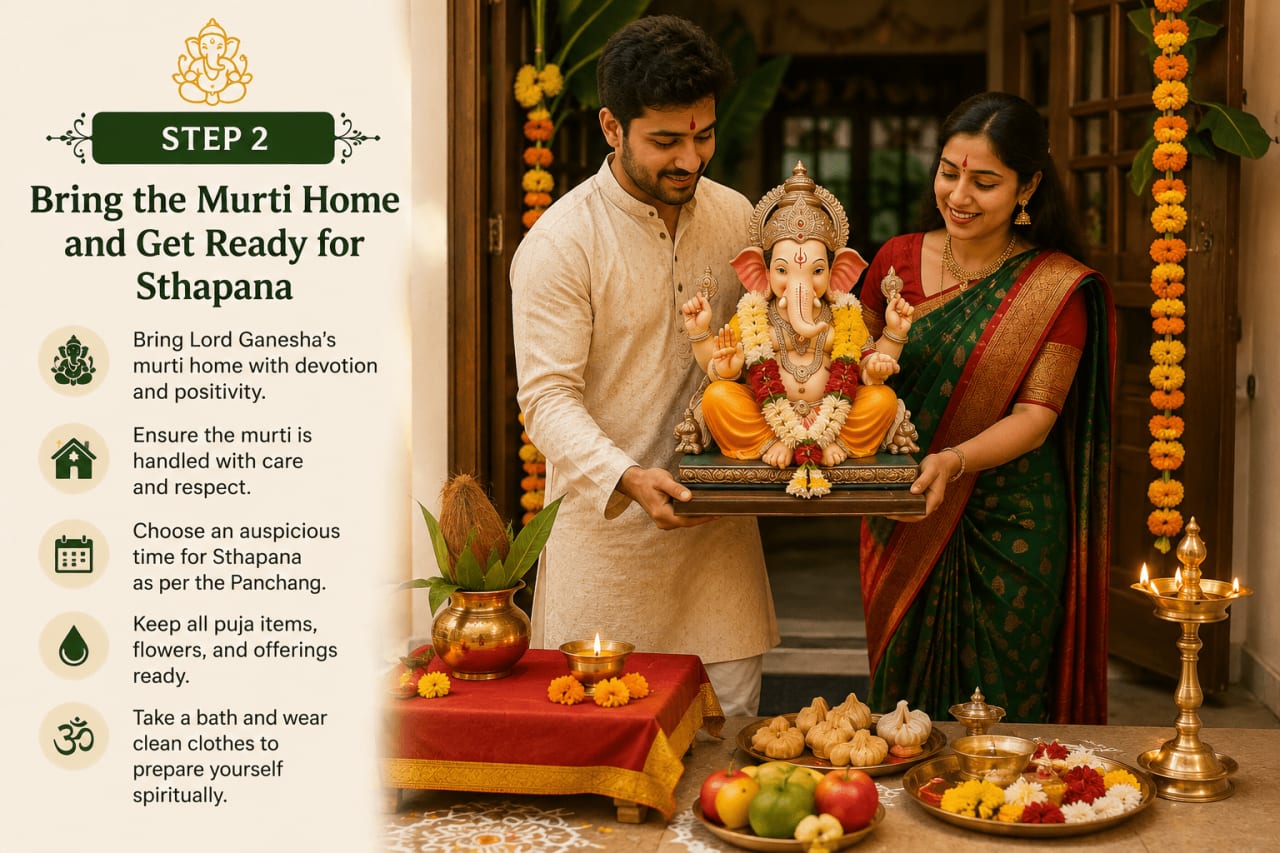
Selecting the murti is worth doing as a family decision, weighing size, material, and budget together rather than in a rush. An eco-friendly clay idol is worth the small extra effort to find, since it makes the eventual visarjan considerably simpler for families who plan to immerse it at home. On the morning of Chaturthi itself, bathe and dress in clean or new clothes before touching the murti or beginning any part of the puja; this is treated as a non-negotiable first step, not a formality.
Step 3: Ganpati Sthapana (Installation) During the Madhyahna Muhurat
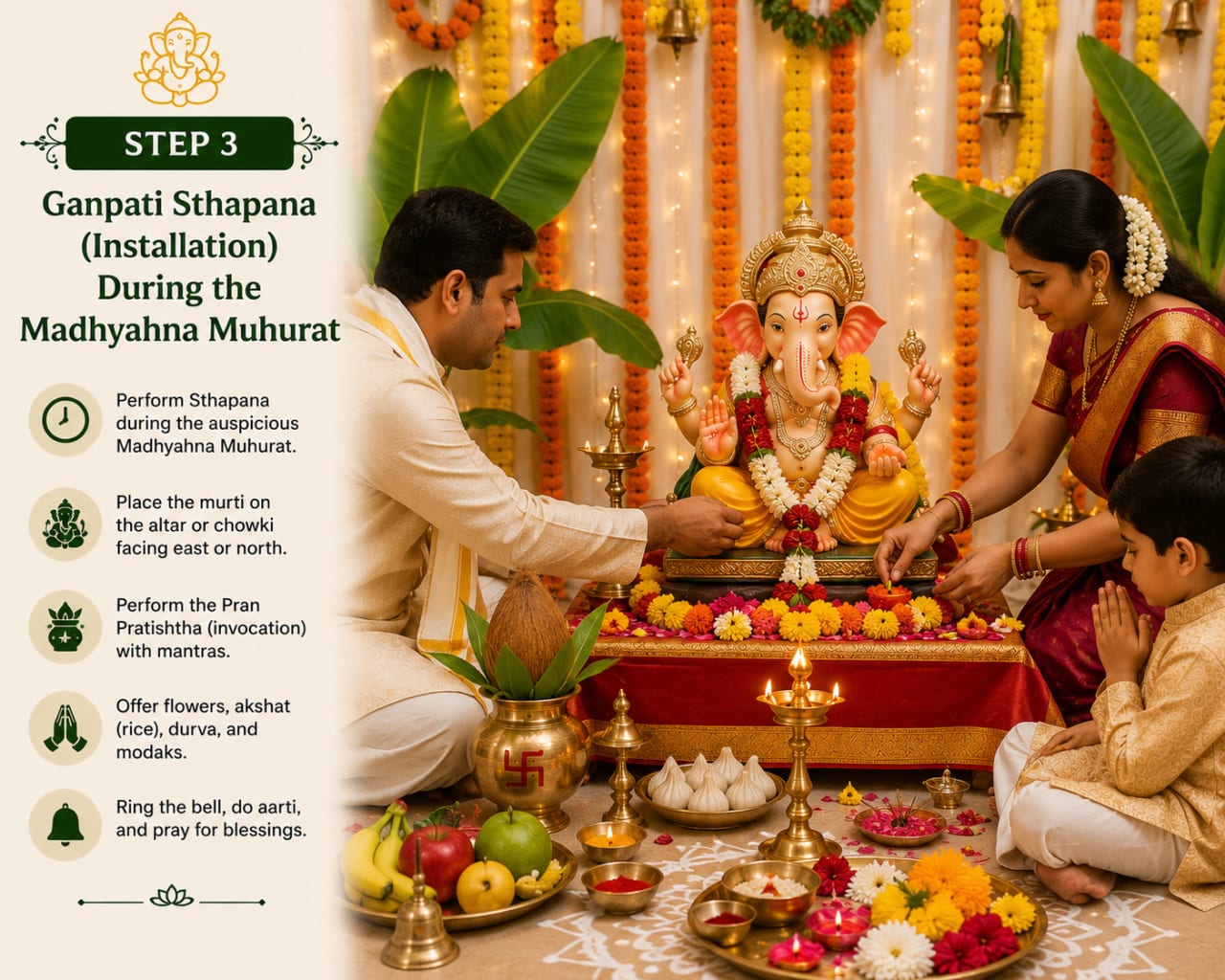
With the space ready and the murti chosen, the installation itself should be completed within the Madhyahna Muhurat window for your city, following this sequence:
- Place the murti on the covered chowki, facing the family or the entrance.
- Light the diya and incense, and sit facing the murti.
- Perform Prana Pratishtha, the ritual of inviting the divine presence into the murti. Join your palms, touch akshata to the idol's forehead, eyes, and heart, and focus the mind on Ganesha while chanting a sthapana mantra.
- A simple mantra that any household can chant is "Om Gam Ganapataye Namah." Families following a fuller tradition also recite the longer Avahana and Pratishthapana mantras from the Shodashopachara sequence, ideally with a family elder or a priest guiding the words.
Step 4: Perform the Shodashopachara Puja (Sixteen-Step Worship)

The full home puja follows sixteen upacharas, or offerings, each paired with its own short mantra and each representing a different act of hospitality toward the deity, much as one would honour a respected guest. A sequence that most households can realistically follow through in a morning looks like this:
- Asana, offering the murti a seat
- Padya and Arghya, symbolically washing the feet and offering water
- Achamana, offering water for sipping
- Snana, bathing the murti with water and, where the material allows, panchamrit
- Vastra, offering a small piece of new cloth
- Gandha, applying chandan (sandalwood paste)
- Akshata and Pushpa, offering rice-turmeric mix, flowers, and durva grass
- Dhoop and Deep, offering incense and the lit lamp
- Naivedya, offering modak, fruit, and other bhog
- Tambula and Dakshina, offering paan-supari and a token gift
- Aarti and Pradakshina, performing the lamp-waving aarti and circumambulating the altar
Households pressed for time need not attempt every step in full. A shortened sequence of akshata, flowers, durva, dhoop-deep, naivedya, and aarti carries the same devotional weight as the complete sixteen-step version; what matters to the tradition is sincerity of intent, not the length of the ritual. If the aarti itself is new to you, our guide on what aarti is and how to perform it walks through the lamp-waving sequence in detail.
The verse chanted most consistently through the puja is the Vakratunda Mahakaya shloka, alongside Ganesh mantras such as "Om Gam Ganapataye Namah." Many families extend this with a recitation of the Ganesh Chalisa, or by singing Jai Ganesh Deva as the aarti is performed. The full set of chants is collected in our Ganesh mantras guide.
Step 5: Daily Worship Through the Festival

For every day that the murti remains at home, aarti is performed both morning and evening, fresh flowers and modak are offered daily, and incense is kept lit through each session of worship. It is this steady, repeated routine, more than any single elaborate ritual, that gives the festival its particular sense of togetherness within a household. The same rhythm carries over into everyday worship, covered in our guide to how to do daily puja at home.
Step 6: Deciding How Many Days to Keep Ganpati at Home
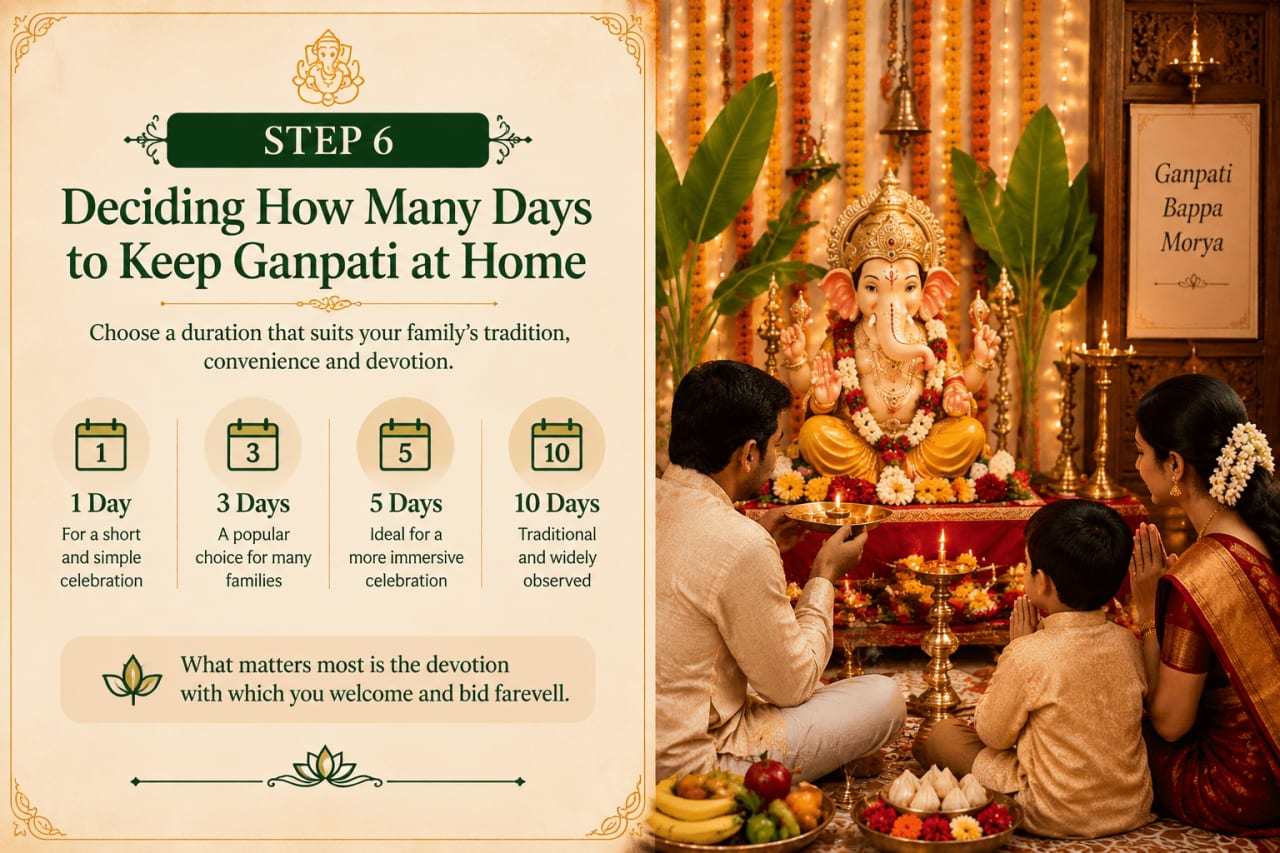
How long the murti stays is a matter of family or kuldevta tradition rather than religious obligation, and no single duration carries more merit than another. The commonly observed options are:
- 1.5 days (dedh din): popular with smaller homes or busy schedules
- 3rd day, 5th day, or 7th day: traditional shorter cycles
- 10 or 11 days, ending on Anant Chaturdashi: the full traditional celebration
Step 7: Visarjan Vidhi (Immersion)

Whichever day a family has chosen, the farewell itself follows a consistent sequence, observed with as much care as the sthapana that opened the festival:
- Perform a short Uttar Puja before moving the murti, offering a final aarti and asking forgiveness for any lapses in the worship.
- Gently move the murti a small distance forward as a symbolic first step of the journey.
- For eco-friendly clay or paper mache idols, immersion at home in a large tub or bucket of water is a practical and environmentally sound option, and the resulting water can later be used for plants in the garden.
- Distribute the prasad among family members.
- Bid farewell with the words "Ganpati Bappa Morya, Pudhchya Varshi Lavkar Ya" (come again soon next year).
For the full immersion calendar and the traditions behind Anant Chaturdashi, see DevMarg's guide to Ganesh Visarjan.
Best Time: Sthapana Muhurat by City (2026)
- New Delhi: 11:02 AM to 1:31 PM
- Mumbai: 11:20 AM to 1:48 PM
- Pune: 11:16 AM to 1:44 PM
- Kolkata: 10:18 AM to 12:46 PM
These timings follow panchang calculations for 2026 and can shift by a few minutes depending on the exact source and precise location; it is worth cross-checking against a local panchang before the sthapana time is finalised.
Conclusion
A home Ganesh Chaturthi puja earns its meaning through attention, not elaborate arrangement. A space prepared with care, a murti welcomed within the sthapana muhurat, a daily discipline of aarti and modak, and a visarjan carried out with the same devotion as the installation, together, are enough to constitute a complete celebration. For muhurat timings across the rest of the year, DevMarg's Muhurat section is worth bookmarking, and the full Ganesh Chaturthi festival guide is a useful next read for regional traditions and the story behind the festival.
Planning your Ganpati sthapana this year? DevMarg's Muhurat section carries exact, city-wise timings, and the Ganesh mantras and Ganesh Chalisa pages are worth keeping close at hand through the puja.
Frequently Asked Questions
What is the Ganesh Chaturthi 2026 date and puja muhurat? Ganesh Chaturthi 2026 falls on Monday, September 14. The Madhyahna Sthapana Muhurat, considered the most auspicious window for installing the murti, runs from approximately 11:02 AM to 1:31 PM in New Delhi, with timings shifting slightly in other cities.
Can Ganpati sthapana be done without a priest at home? It can, and most households do exactly this. The sthapana and the full puja can be performed by the family itself, using accessible mantras such as "Om Gam Ganapataye Namah" and the sequence set out in this guide. A priest adds value for the complete Vedic recitation, but the ritual is not considered incomplete without one.
Why is the Madhyahna Muhurat considered best for sthapana? Tradition holds that Lord Ganesha was born around midday, which is why the Madhyahna period, broadly the two to three hours surrounding solar noon, is treated as the year's most auspicious window for installing his murti.
How many days should Ganpati be kept at home? There is no fixed rule here; the choice rests with each family's own or kuldevta tradition. Households typically settle on 1.5 days, 3 days, 5 days, 7 days, or the full 10 to 11 days concluding on Anant Chaturdashi, and none of these is regarded as more correct than the rest.
What are the essential items for Ganesh Chaturthi puja samagri? At minimum, a household needs the murti, a chowki with cloth, flowers, durva grass, akshata, kumkum, incense, a diya, and fruit or modak for naivedya. Families wishing to follow the complete Shodashopachara sequence will find the fuller list earlier in this guide.
Can visarjan be done at home instead of a river or lake? Yes, and this practice is increasingly recommended. Eco-friendly idols made of clay or paper mache can be immersed in a large tub or bucket of water at home, sparing natural water bodies from added pollutants and allowing the water to be reused for plants afterward.
Is it necessary to chant Sanskrit mantras, or can the puja be done in simple words? Sanskrit mantras carry the weight of tradition, but the puja does not depend on flawless pronunciation to be valid. Families more at ease in their own language can offer prayers accordingly, alongside the basic "Om Gam Ganapataye Namah" chant, and the worship remains complete in every sense that matters.